 Bare-throated Bellbird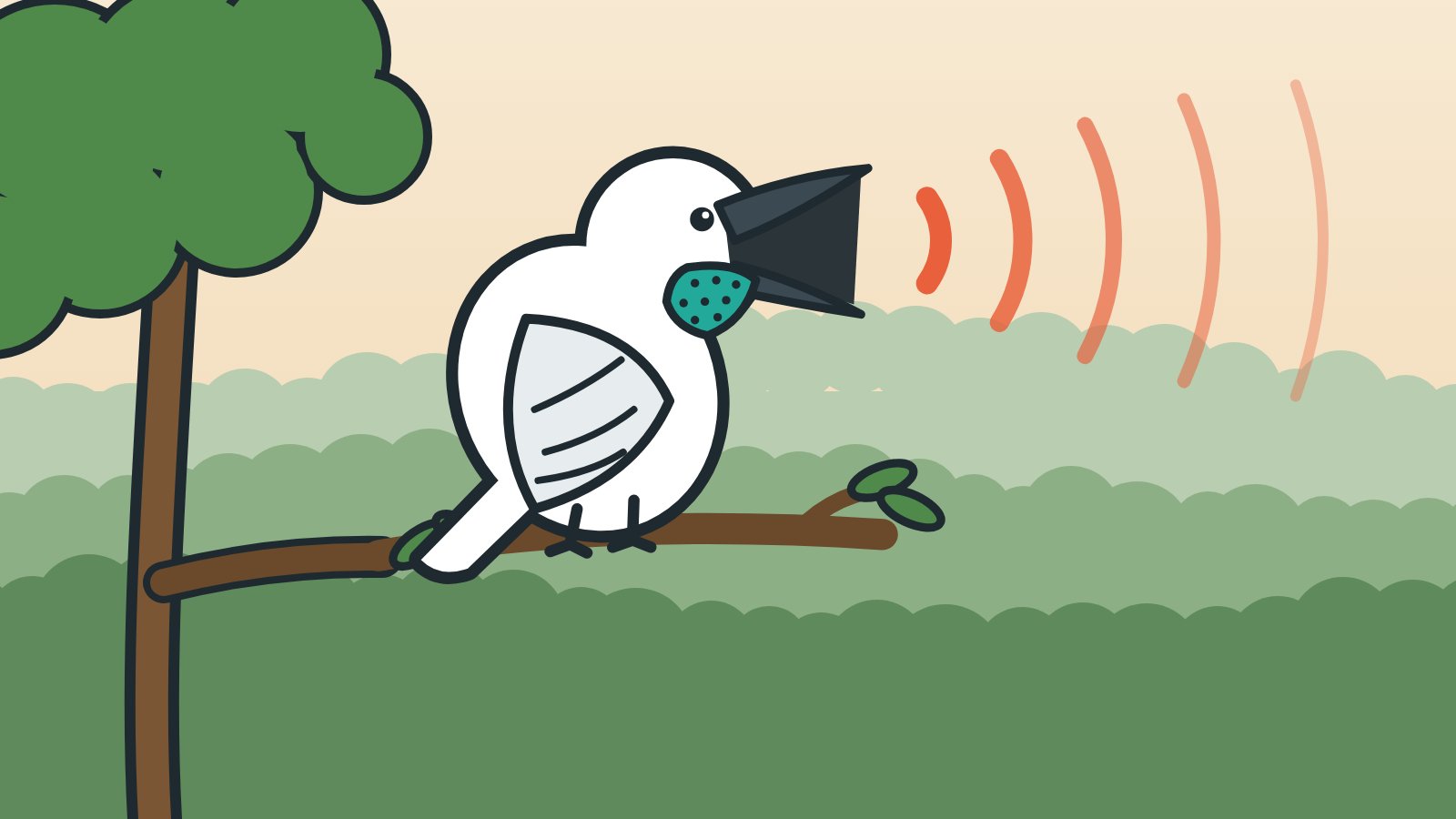
A golf rangefinder is built to answer one question: how far is it to the flag? Jeff Podos, a biologist at the University of Massachusetts Amherst, pointed his at birds.
Paired with a handheld sound meter of the kind used to check noise in workplaces, it let Podos and his former graduate student João Menezes measure how loudly 123 bird species call, in Massachusetts and across Brazil. Their study, published September 29 in the journal Evolution, found two species whose calls top 120 decibels. That is louder than a jackhammer.
One of them is a snow-white bird with a patch of bare, blue-green skin at its throat: the bare-throated bellbird.
Why a golf gadget?
A call sounds quieter the farther away you stand, so a volume reading means little unless you know the distance too. Catching wild birds and testing them in a lab wasn't practical at this scale. The rangefinder solved the problem by reading the distance at the same moment the meter read the sound, so every call could be corrected for distance.
Most of the birds had never been measured this way. By the university's count, 113 of the 123 species had no volume on record. The quietest was a hummingbird, at about 64 decibels, roughly the level of a conversation. The loudest calls came in 58 decibels higher.
Meet the bellbird
The bare-throated bellbird lives in the Atlantic Forest of South America, mostly in Brazil. Males are bright white, with that bare blue-green throat. In the breeding season they call from perches high in the canopy, and the call is usually described as metallic and piercing. The species eats fruit, and in doing so it spreads the forest's seeds.
In the new measurements, its calls topped 120 decibels, and its single loudest call peaked close to 131.
So which bird is the loudest?
The title isn't settled. In 2019, Podos and the Brazilian ornithologist Mario Cohn-Haft measured the white bellbird of the northern Amazon at about 125 decibels, and Guinness World Records lists it as the loudest bird call. The bare-throated bellbird is a close relative. The other new contender, the red-legged seriema, is a bird of open country.
Which one comes out on top depends on how you count: the single loudest call from one bird, or the average across several. For the researchers, the bigger question is why any bird got this loud.
The 2019 study left the most retold detail. Females would join a male on his display perch, and that was when he sang his loudest song, swinging his head to aim the final note straight at her. Podos suggested the females might be judging the males up close, even if it is hard on their ears.
The how, but not yet the why
Across all 123 species, size predicted volume. Bigger birds with wider beak openings called louder. Menezes's explanation: bulkier muscles build more pressure, and a wide-open beak lets the sound out, much as the flared bell of a trumpet does.
The why is harder. The team expected the loudest birds to be ones that live in dense forest, where a call has to carry, or that compete for many mates. The bellbirds fit that picture. The seriema doesn't: it lives in open country and pairs with one partner, and it still tops 120 decibels. Menezes has said the team now knows some of the hows, and that the whys will take data from many more species.
Listening for more
And 123 species is a small share of the world's birds, so louder ones may still be out there, unmeasured.
The bare-throated bellbird has a more pressing problem than its ranking. It is listed as Vulnerable: its forest has been cleared for farms and roads, and birds are trapped for the cage-bird trade.
If you want to hear one, the UMass Amherst and Boston.com stories on the study include video of the calls. Turn the volume down first. The bellbird never does.