Deep-Sea Fire Rocks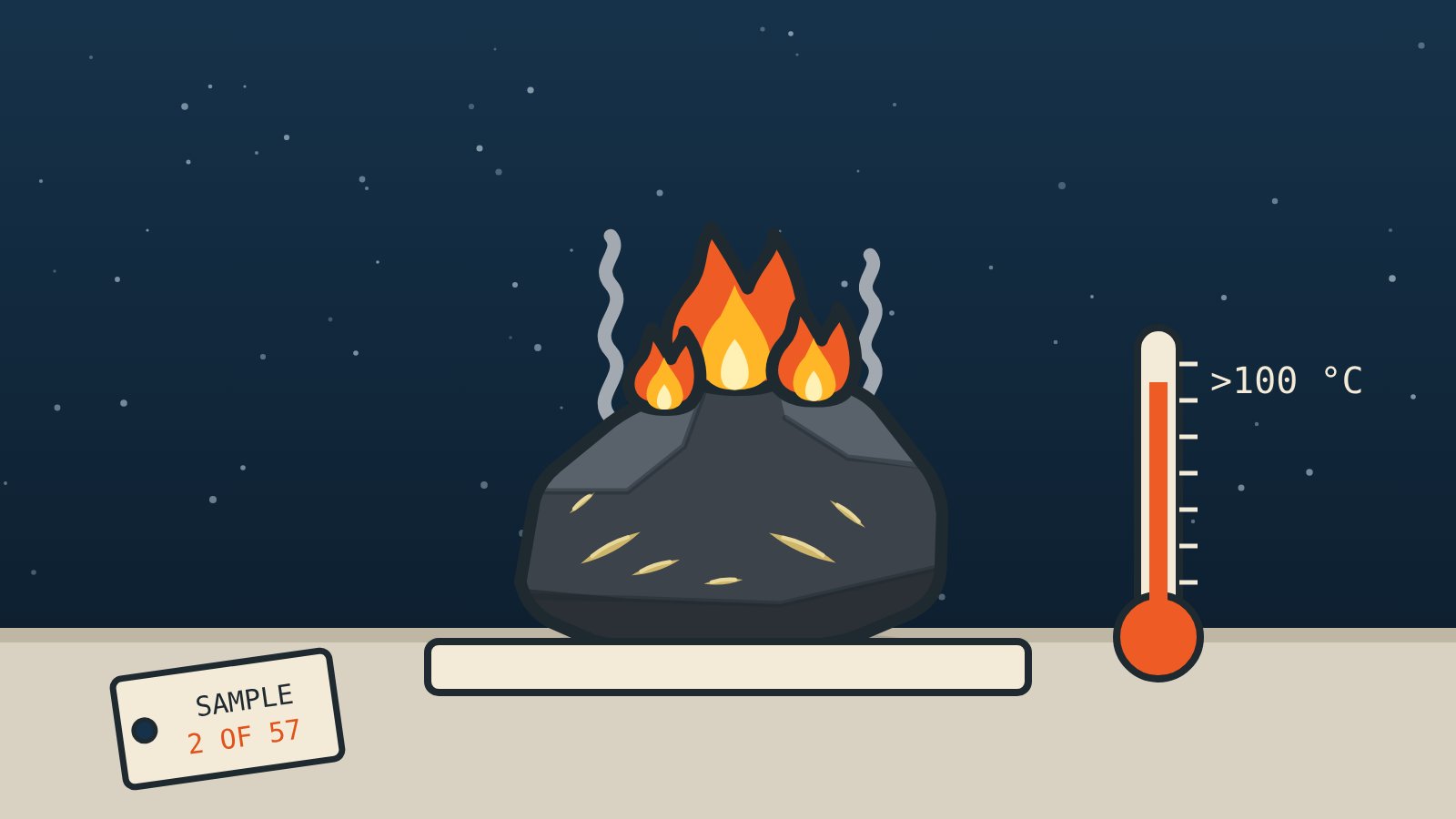
In May and June of 2022, a remotely operated vehicle named Jason made dives about 3,300 meters down, almost 200 miles off northern California. Its job was to collect rocks from Escanaba Trough, a hydrothermal area where hot, metal-rich fluid meets cold seawater and leaves minerals behind.
Fifty-seven of those rocks went to the lab. Two of them later combusted on their own.
That is the finding of a study led by U.S. Geological Survey research oceanographer Amy Gartman, published in late September in the journal Scientific Reports and announced by the agency on October 7. The team set out to learn why those two rocks burned when the others didn't.
What happened on the bench
It happened during routine lab work, as the rocks were being prepared for analysis. The samples were freeze-dried to remove their water, then broken up to be crushed into powder. As fresh surfaces met the air, two of them began to heat up by themselves.
They passed 100 °C, hotter than boiling water, and kept going until the original rock was completely oxidized.
Nobody lit them. The heat came from a reaction between the rock's iron sulfide minerals and oxygen. That reaction gives off heat, and the heat drives more of the reaction, a loop known as self-heating.
A cousin of fool's gold
The two rocks that burned had something in common. Both were made mostly of marcasite, an iron sulfide with the same chemical formula as pyrite, the brassy mineral nicknamed fool's gold. The difference is in how the atoms are arranged.
In the Escanaba rocks, the marcasite had formed as crystals measured in nanometers. It had taken the place of blades of an older iron sulfide called pyrrhotite while keeping their shape, like a cast of the original.
That swap turned out to be the weak point. The researchers say marcasite isn't usually singled out as a hazard, but it may be especially unstable.
Collectors already knew it was touchy
Marcasite has a reputation among mineral collectors. It is the mineral most prone to what they call pyrite decay: a specimen slowly crumbles into a white powder that can turn acidic and damage what sits next to it. Collection-care guides advise storing it carefully.
There is a jewelry twist, too. The sparkly "marcasite" sold in jewelry is usually pyrite. Real marcasite isn't used as a gem.
Why it matters beyond the lab
Rocks like these are more than a curiosity. Deposits that build up around hydrothermal vents, called seafloor massive sulfides, are rich in metals such as zinc, and they are being studied as possible mineral sources.
Similar deposits on land are already mined. But the authors say the Escanaba material is different enough that safety methods built for land deposits may not carry over. Hauling a rock up from the seafloor changes the oxygen, temperature, pressure and moisture around it, and each of those can change how much heat it gives off.
What comes next
The researchers are careful about what the study doesn't show. It doesn't establish that every seafloor sulfide deposit will combust. What they ask for is specific: dedicated risk assessments and engineering controls for handling these materials if seafloor mining goes ahead.
The 2022 expedition's field logs, written while the dives were under way, are still on NOAA Ocean Exploration's site, and the USGS has written up the study for a general audience.
Fifty-five of the Escanaba rocks behaved like rocks. The other two were a reminder that some just run hot.