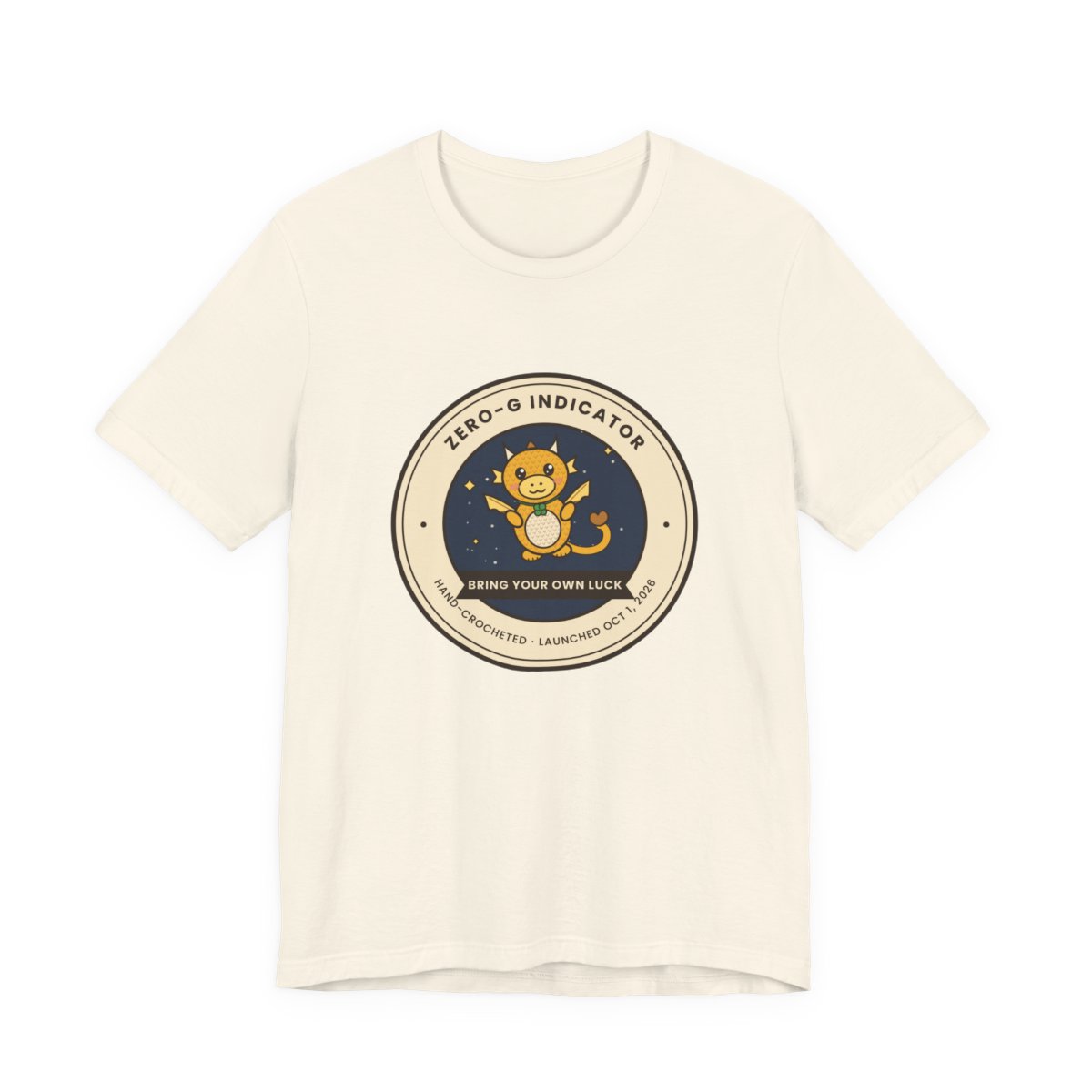
 Lucky the Zero-G Dragon
On October 1, 2026, a Falcon 9 rocket lifted off from Cape Canaveral carrying four people in a Dragon capsule named Grace. Somewhere in the cabin was a fifth passenger: a small golden dragon, crocheted by hand, wearing a four-leaf clover.
The crew called it Lucky. Commander Jessica Watkins said her sister-in-law crocheted it to stand for the dragon at the center of the mission's patch. When Lucky began to drift on its tether, the crew had their first simple proof that they were weightless.
Less than eight hours after launch, the capsule docked at the International Space Station. Dragon trips there have usually taken 15 hours or more, and this was the fastest yet for an American spacecraft.
What a zero-g indicator does
A zero-g indicator is a small toy on a tether inside the spacecraft. While the rocket is still pushing, it hangs. Once the crew reaches orbit and everything around them becomes weightless, it lifts and floats, which anyone in the cabin, or watching the broadcast, can see at a glance.
The custom comes from the Soviet and Russian space program, where crews have flown dolls and stuffed toys for decades. SpaceX's Crew Dragon picked it up on its first flight to the station, an uncrewed test in March 2019, which carried a plush Earth beside a test dummy. Since then, nearly every crew has chosen its own.
Why a dragon, and why gold
Lucky was made to match the Crew-13 patch, and the patch was made to honor Apollo 13. At its center is a golden dragon gazing upward. Watkins said the crew took a lot of inspiration from the Apollo 13 astronauts and pointed to the nods: the Roman numerals, the gold, and the dragon looking up, which echoes the golden horses on the 1970 patch as well as the spacecraft's own name.
The clover is a SpaceX touch. The company put a four-leaf clover on the patch for its first successful orbital launch in 2008, and every SpaceX patch since has carried one.
Is 13 unlucky?
For a long time, NASA acted as if it might be. Apollo 13 launched in April 1970 and had to abandon its Moon landing after an explosion on the way out, though its crew made it home safely. Astronaut Bob Crippen later recalled that NASA administrator Jim Beggs wanted no Shuttle 13, so the flight that would have been STS-13 flew in 1984 as STS-41-C, under a new numbering scheme.
Others shrugged. Russia has flown crewed Soyuz missions numbered 13, and a space shuttle flew as STS-113 in 2002.
Crew-13 leaned in. The astronauts rode to the launch pad in cars with "Lucky 13" plates, and Watkins said the crew wanted to honor the Apollo 13 astronauts' grit and resilience and take some of it along.
Made at home, headed for orbit
Plenty of zero-g indicators have been store-bought plush toys. Lucky was made at home, stitch by stitch, for one crew and one patch. That may be why so many people went looking for it.
Crew-13 is aboard the station for about six months. The crew is NASA's Jessica Watkins and Luke Delaney, the Canadian Space Agency's Joshua Kutryk and Roscosmos cosmonaut Sergey Teteryatnikov. What happens to Lucky after that hasn't been said.
So the next time a launch broadcast cuts to the cabin, watch for the little thing on the string. When it floats, they made it.